
Hello. I'm conducting a check of anchor bolts installed into a masonry wall (type HIT-HY 170 HAS-U A4 M12) and I've noticed that Hilti PROFIS Engineering forces me to select an anchor bolt of length 110. Crucially this means that I am unable to prescribe an embedment depth and I must accept the 80mm given to me. Why does the software impose these limits and is it possible to change the anchor bolt or embedment depth in any way for this type of injection resin?
Hi,
Thank you for your query. Please find our response below:
For anchoring into masonry, we rely on our testing and experience as well as AEFAC’s advice due to the absence of a standard/code for post-installed anchors into masonry in Australia. For example when anchoring into masonry base materials, using larger diameter rod doesn’t necessarily increase the anchor capacity because the pull-out capacity of the anchor is governed by the strength of the base material.
European Technical assessment documents are produced after vigorous testing, and they are recognised as prequalification document.
As part of our ETA approval, we have tested our HY170 and HY270 anchor in several masonry units but there are hundreds of masonry suppliers with different products. If the material compressive strength, unit size and hole configuration of your masonry unit matches with one of the tested prototype available in ETA, you can take corresponding values. Otherwise, anchor capacity in masonry shall be determined based on on-site pull tests. With this in mind, an effective embedment depth of 80m was tested against all the tested masonry units. In each of the products technical datasheets, we have further test specimens and data you may also refer to.
The software is limited by what has been tested for embedment depths and capacity values. The engineer on the project can make a judgement call and advise that going deeper will lead to an increased capacity. However without testing, this is unknown. Also with close edge and anchor spacing, deeper may not always lead to an increased capacity.
Masonry is a heterogeneous base material. The hole being drilled for an anchor can run into mortar joints or cavities. Owing to the relatively low strength of masonry, the loads taken up locally cannot be particularly high. A tremendous variety of types and shapes of masonry bricks are on the market, e.g. clay bricks, sand-lime bricks or concrete bricks, all of different shapes and either solid or with cavities. Hilti offers a range of different fastening solutions for this variety of masonry base material. If there are doubts when selecting a fastener / anchor, your local Hilti sales representative will be pleased to provide assistance. When making a fastening, care must be taken to ensure that a layer of insulation or plaster is not used as the base material. The specified anchorage depth (depth of embedment) must be in the actual base material and due to these limitations, tests were only conducted up to 80mm effective.
Unfortunately this means, the anchor embedment and diameters in PROFIS are limited to what is available in the ETA, anything outside this scope will require an engineering judgement.
Brick pull-out:
It is one of the predominant mode of failure and would be hard to estimate as per the ETAG 029 Appendix C because of 2 factors requiring your judgement:
- Compressive stress, which increases friction against brick pull-out.
- Corresponding area of mortar joint would be tricky to calculate if more than single brick is involved in deep embedment. For example, codes takes 2xLxB with compression friction plus mortar strength, which engages blue brick below but if the embedment is deeper than single brick width, actual brick pull-out strength would be much higher (shown green).
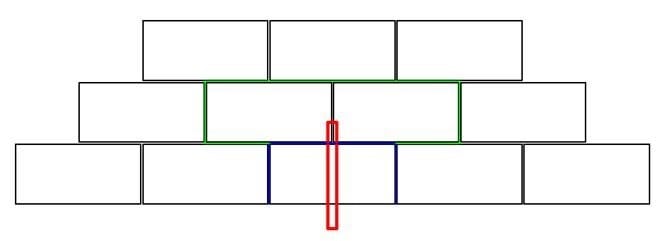
Please refer to masonry anchoring code of practice note by AEFAC below:
AEFAC Technical Note
Kind regards,
Ask Hilti Team
Australia