
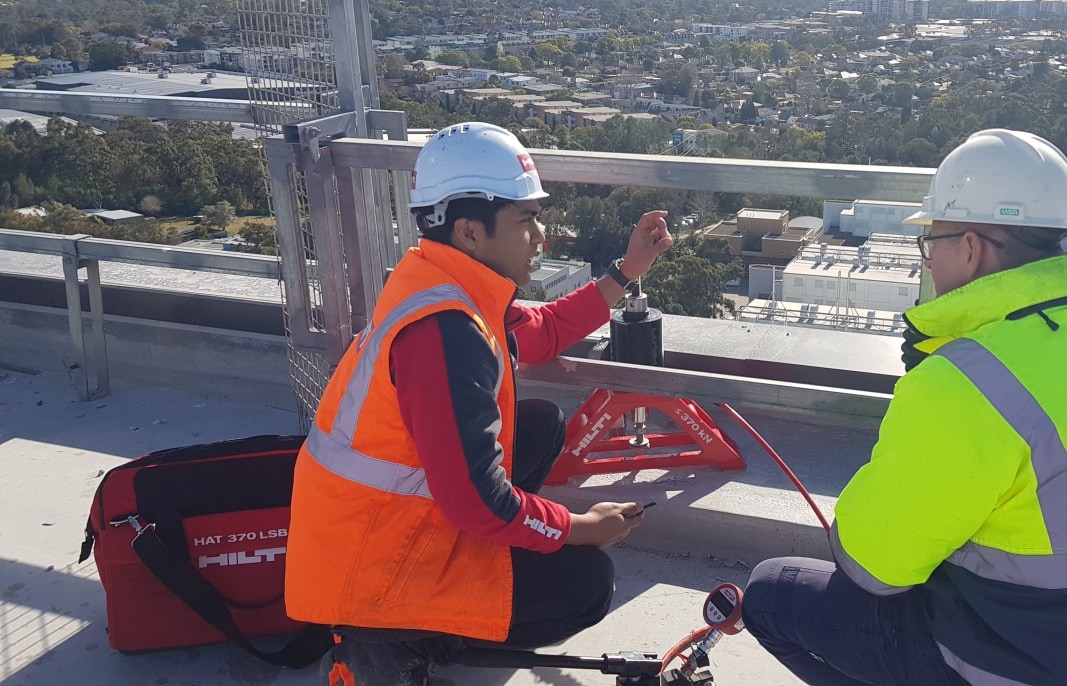
How should you specify on site testing for post installed anchors and rebar?
Do you have trouble sleeping at night because you’re not sure whether or not those anchors will hold? Having nightmares of poor installation or unpredictable base material strength causing catastrophic anchor failures? It may comfort you to know that you’re not alone.
The fastening space is developing quickly and it’s certainly heading in a better and safer direction however, there are still a few areas which aren’t exactly concrete (excuse the pun). Anchor testing falls firmly in this category. Whilst many engineers, and indeed installers, are sure that it’s a good idea to test the anchors post-installation, they are not always sure of the details – what, why, when, how, who?
Many designers may turn to AS5216:2018, the most recent anchor standard detailing specifics for designing post-installed anchors (and cast-ins) in concrete. They will discover no fruit and no joys in return for their efforts of seemingly endless scrolling. The standard is explicitly clear on the requirements for post-installed fasteners to be thoroughly pre-tested and approved for use (EAD 330232 and EAD 330499), however, there are next to no references to testing the integrity of post-installed anchors, well, post-installation.
Fear not, the Australian Engineered Fasteners and Anchors Council (AEFAC) is here to help. This nifty bunch have compiled a set of technical notes named “site testing guidelines” to help you sleep better at night.
Why and when?
Rule number one is that site testing is by no means a replacement or substitute for an ETA. All safety critical designs must be designed in accordance with the standards and using data provided by the relevant fastener’s ETA. An on-site test’s results can never be used to trump the findings from an ETA. This is largely due to the fact the ETA values are based on years of laboratory testing and take into account a multitude of factors that a short-term on-site test simply cannot. Volume 1 of the AEFAC site testing guidelines make this quite clear on the first page where the scope is outlined.
If that leaves you scratching your head a little bit about the purpose of an on-site test when there is already very robust ETA data available, that’s good! On-site testing is never a means to confirm results from an ETA. Rather, it is a means to assess anchor integrity on the basis of two fundamental concerns:
· Installation quality
· Base material uncertainty
This calls for a graphic (or two):


Note: Volume 3 of the AEFAC guidelines also have a useful flowchart.
Aefac.org.au. (2019). [online] Available at: http://www.aefac.org.au/documents/Site-testing-Vol3.pdf [Accessed 15 Sep. 2019].
How many and what load?
Section 7.2 of Volume 2 of the AEFAC guidelines elaborates on the number of tests that should be taken; i.e. population size. It highlights that the selection of anchors should be random and that this must be assessed by the design engineer on a case-by-case basis. That said, it does suggest a minimum of 3 test specimens or 2.5% of the total relevant anchor population (for concrete).
Generally, testing requirements are based largely on how critical the application is and how much uncertainty there may be in the anchor’s performance. For instance, a high percentage of anchors in sandstone, shale and rock are often tested (50% and above). Fall arrest systems have a strict requirement of 100% of anchors tested. Additionally, if two or more failures occur in the sample range, all anchors must be tested, and all failures must be communicated to the responsible design engineer.
Guidance is also given on loads required for the tests. Section 4 of Volume 2 of the AEFAC guidelines dictates that the proof load can be calculated using either a capacity reduction factor (0.67 for concrete) on the characteristic resistance or as much as a 1.5 multiple on the allowable working load. In either case, the anchor must not be allowed to yield.


Note: Volume 2 of AEFAC provides test load limits.
Aefac.org.au. (2019). [online] Available at: http://www.aefac.org.au/documents/Site-testing-Vol2.pdf [Accessed 15 Sep. 2019].
For further guidance and information, please refer to the AEFAC guidelines or reach out to community on the ASKHILTI forum.